
Sorrento & Pompeii – From Lemon Groves to Lost Cities
A scenic coastal drive led us from sunny Sorrento’s lemon shops to the lost city of Pompeii
Sorrento & Pompeii – From Lemon Groves to Lost Cities
24 October 2025 – Port of Naples, Italy
Morning Departure
Our plan for today was to visit Sorrento and Pompeii, both located south of Naples. We had the option to start in Sorrento and visit Pompeii on the way back, or to reverse the order.
Our philosophy for shore excursions is simple: go to the farthest point first, then work your way back toward the ship. This way, you’re always closing the distance, reducing the risk of being stranded far away with little time to recover. Based on that logic, we chose to visit Sorrento first and Pompeii in the afternoon.
We purchased express line tickets for Pompeii with an entry window from 1:00 PM to 5:00 PM. Our arrangements were made through MrCabDriverNapoli, who also arranged for a local guide to lead us through the ruins at Pompeii.
Our group of five met in the Deck 3 atrium at 8:00 AM, and the ship was cleared a few minutes later. Another cruise ship — Royal Caribbean’s Allure of the Seas — shared the port with us that day.
We left the ship via the forward gangway, walked aft along an elevated walkway to the terminal, then doubled back through the building, passing several shops before descending the escalators to the main exit.
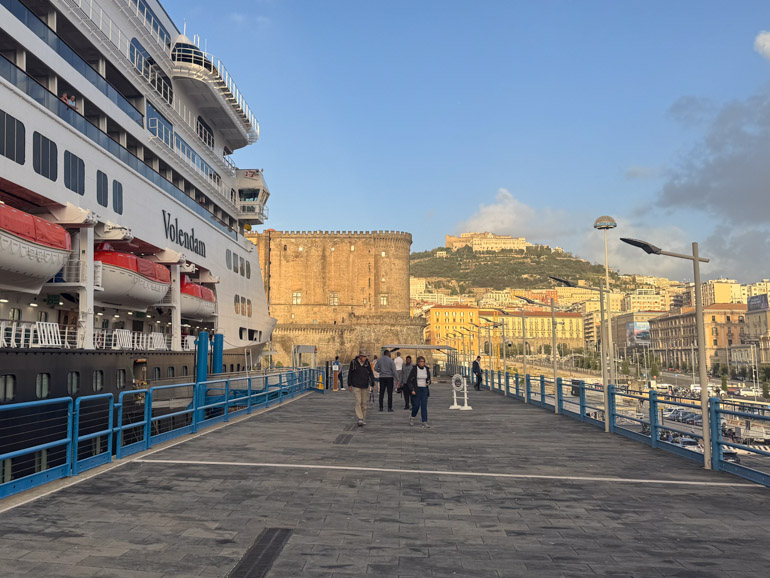
We had to backtrack on this elevated platform to get into the Naples cruise terminal
Outside the terminal, our driver-guide, Roberto, greeted us around 8:15 AM, and within minutes we were on our way in his comfortable van, ready for a full day of exploring Sorrento and Pompeii.

A view from the ship of the private tour scrum outside the cruise terminal
The drive south followed a scenic two-lane coastal road that wound along cliffs with sweeping views of the Bay of Naples and Mount Vesuvius. Morning traffic was heavy in the opposite direction, but we moved smoothly against the inbound commute.
Photo Stop on the Sorrento Coast
Around 9:30, we stopped for photos near Meta and Piano di Sorrento, with spectacular views of the Sorrentine Peninsula. The day was slightly hazy — on a clearer morning, we might have seen Capri — but the coastal scenery was still stunning. After a few minutes, we continued, arriving in Sorrento around 10:00 AM
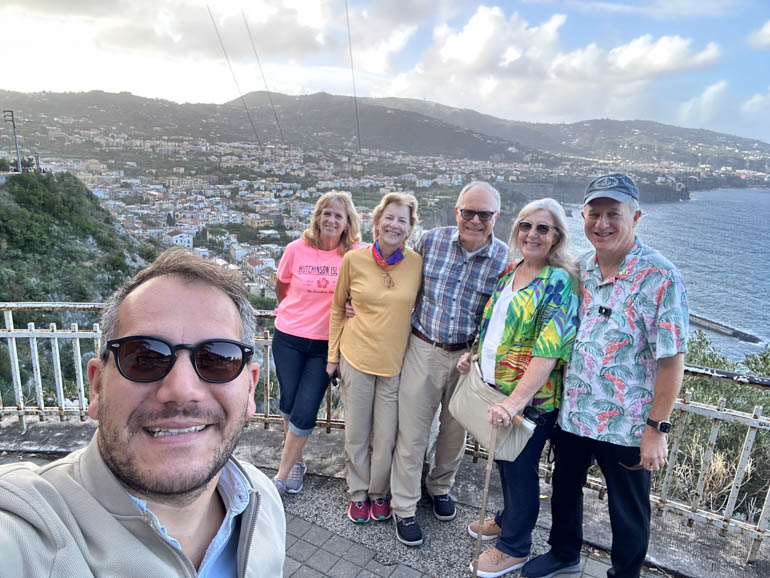
Our driver, Roberto, and our crew overlooking the Sorrentine Peninsula
Exploring Sorrento
Roberto dropped us off near Piazza Tasso in the center of town and gave us 90 minutes to explore before meeting back at 11:30 AM.
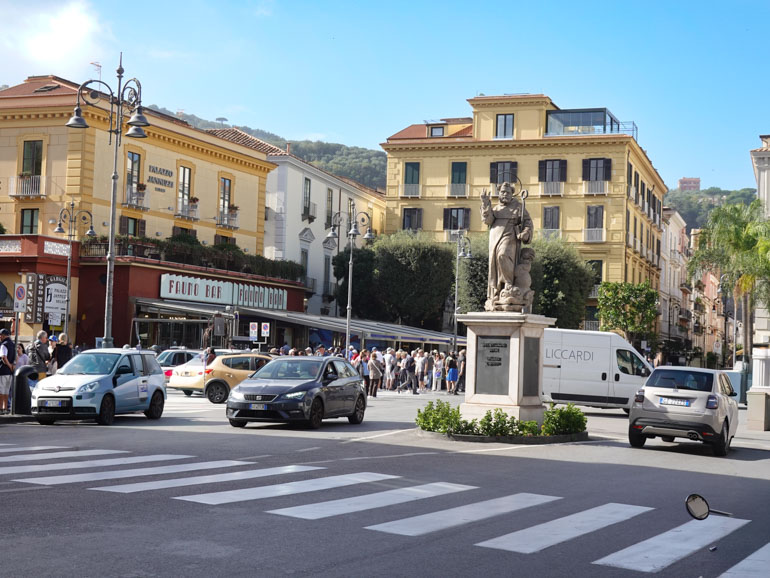
Piazza Tasso
Our first stop was a small limoncello shop, where we sampled traditional limoncello and a creamy pistachio-cello. The owner’s 80-year-old mother, Adella, still made the jams and chocolates by hand. We bought a T-shirt, keychain, and ball cap before walking toward the Belvedere viewpoint above Marina Piccola, near Chiesa della Madonna del Soccorso. The overlook offered beautiful views across the bay toward Vesuvius.
-
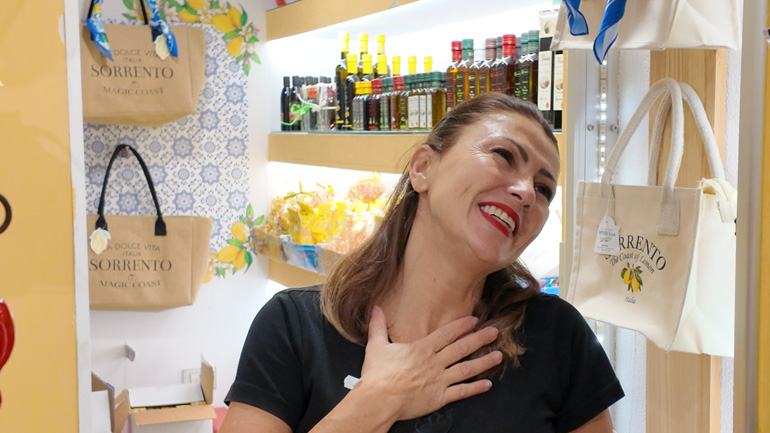
- Shop owner talking about her mother still making the jam sold in the shop
-
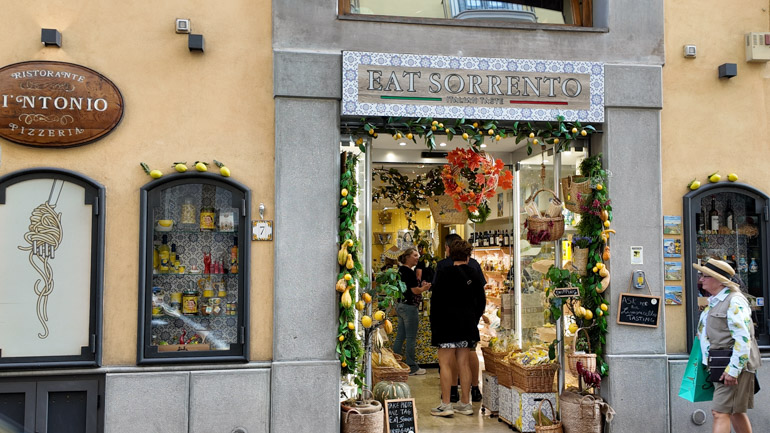
- Eat Sorrento – Lemon Shop
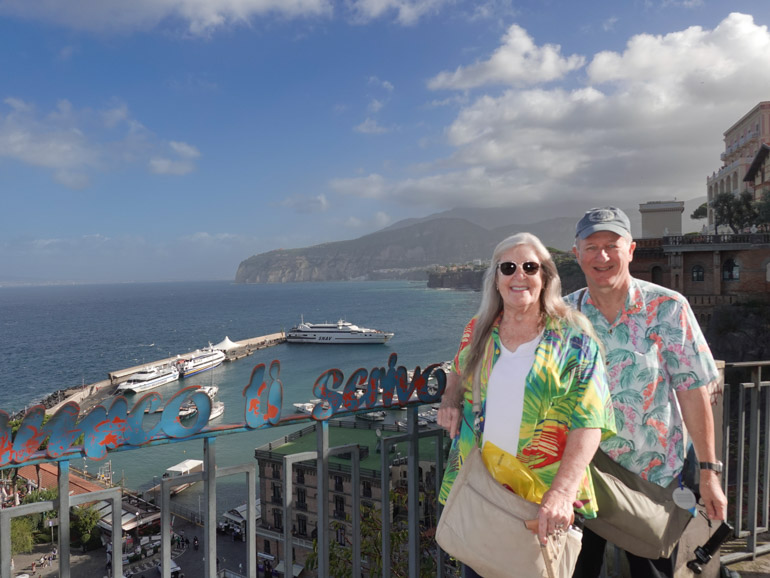
Belvedere viewpoint above Marina Piccola,
Everywhere we turned in Sorrento, the color yellow seemed to shine — bottles of limoncello, soaps, candies, and hand-painted ceramics in every shade imaginable. The narrow lanes were lined with shops and cafés catering to visitors, yet the atmosphere remained cheerful and lively.
-
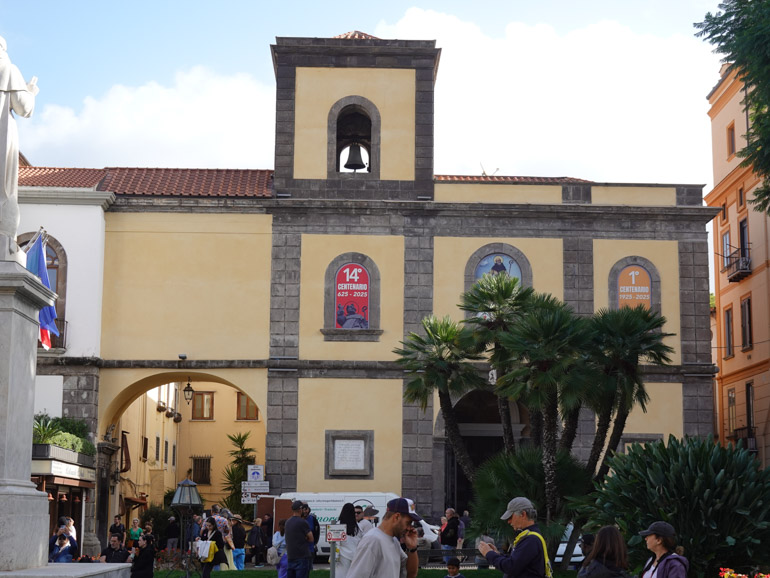
- Sant Antonino Basilica
-
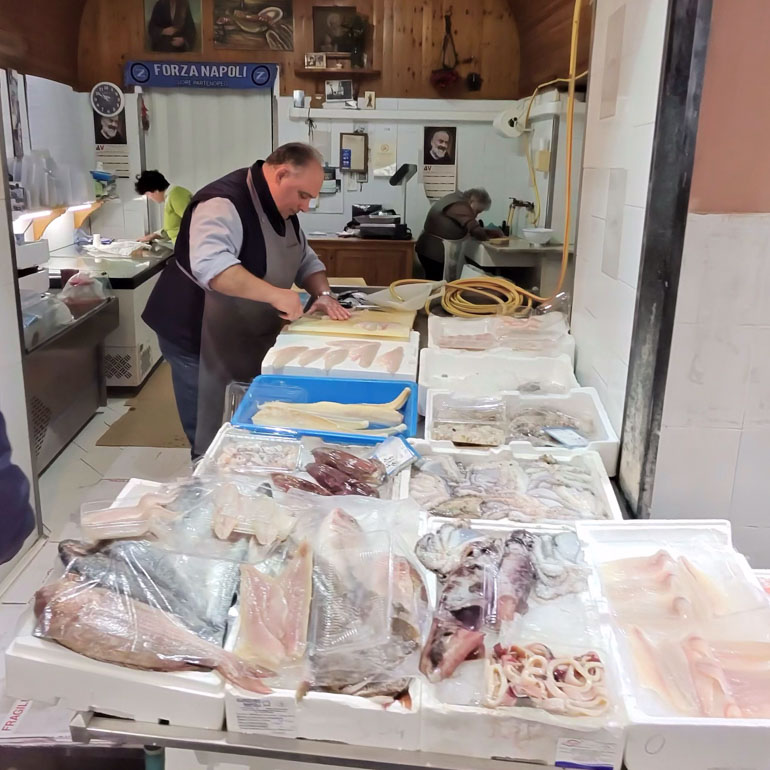
- Shopkeeper preparing the days fresh fish for sale
-
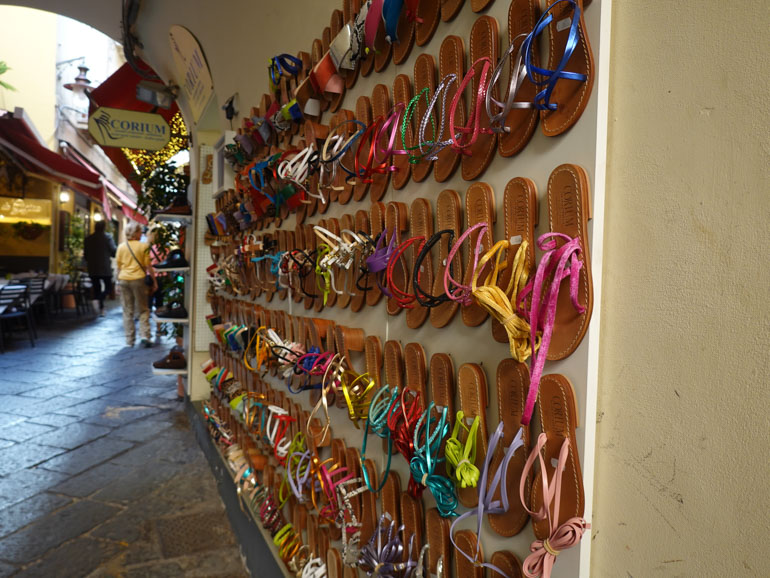
- Colorful sandals for sale
-
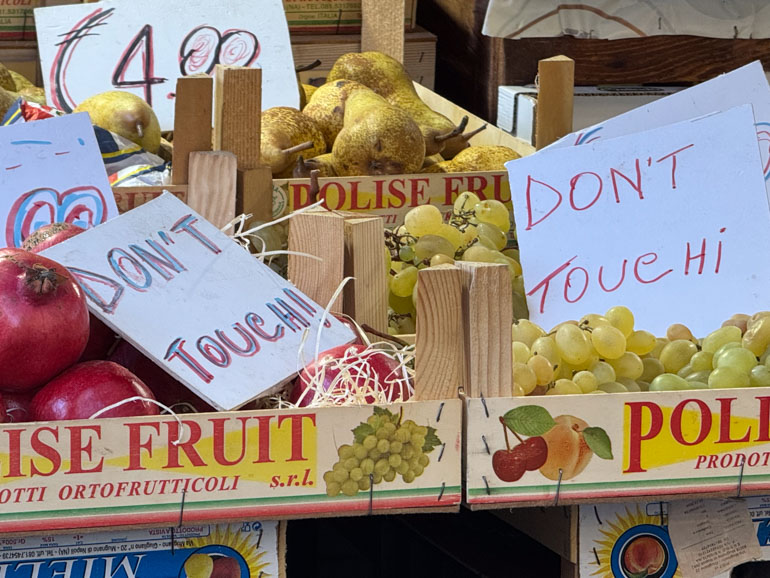
- Fresh Fruit for sale – no samples!
-
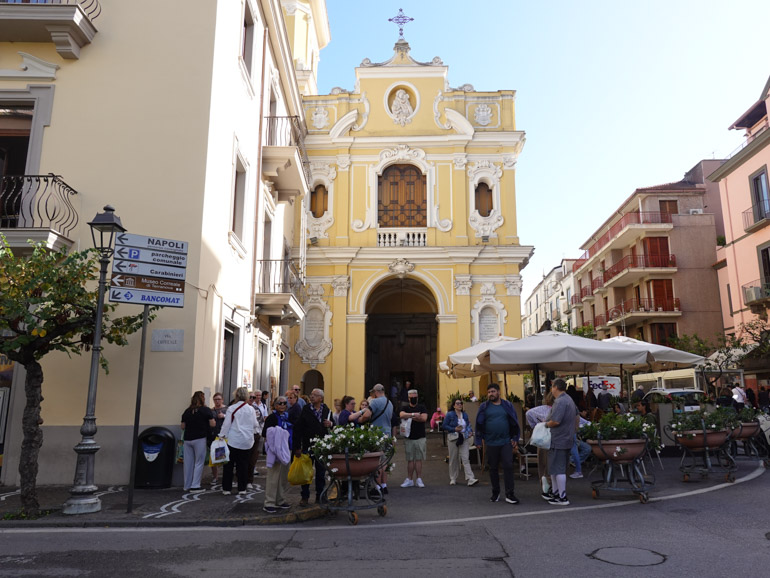
- Santuario della Madonna del Carmine, located just off Piazza Tasso in Sorrento, Italy. The church’s bright yellow Baroque façade with white trim is one of Sorrento’s most recognizable landmarks. It dates to the 16th century but was renovated in the 18th century in its current ornate style. Inside, it houses beautiful frescoes and a revered statue of the Madonna del Carmine (Our Lady of Mount Carmel).
-
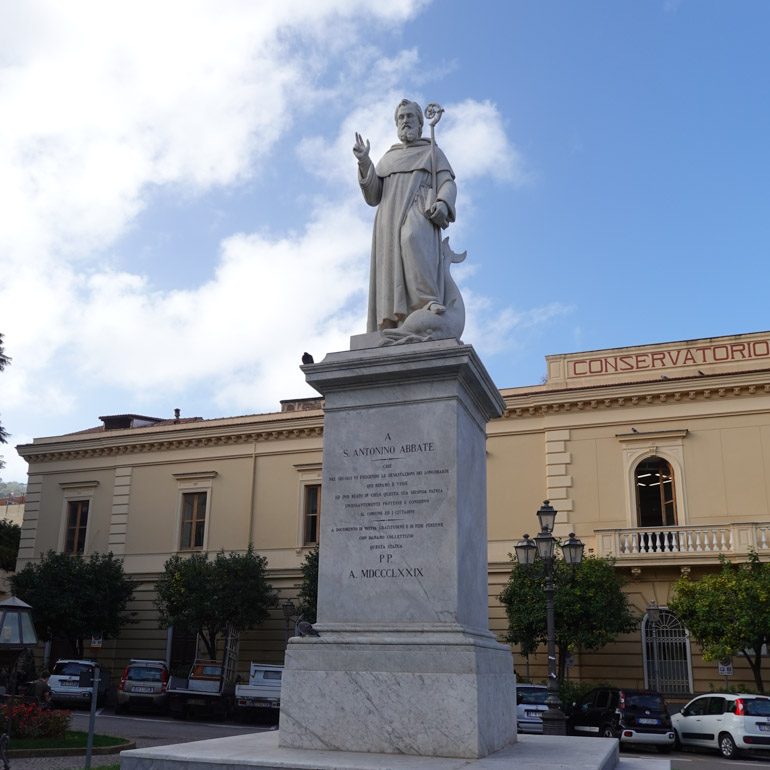
- S. Antonino Abbate
While Sorrento is a charming town with plenty of shops and restaurants, we agreed that, given the relatively short port day, the time spent here might have been better used exploring Pompeii more thoroughly or visiting other sites in Naples.
By 11:20, we were back near Piazza Tasso, ready to meet Roberto for the drive to Pompeii.
Pompeii vs. Pompei – What’s the Difference?
Pompeii and Pompei refer to two intertwined but distinct places in southern Italy.
Pompeii (with two “i”s) is the ancient Roman city buried under volcanic ash when Mount Vesuvius erupted in AD 79 — now a UNESCO World Heritage archaeological site.
Pompei (with one “i”) is the modern Italian municipality of about 25,000 residents that developed around the ruins in the 19th century.
The spelling difference reflects Latin’s plural nominative ending “-ii” for the historical name versus Italian’s simplified form for the modern town, though geographically the ruins lie within today’s city limits of Pompei.
Lunch at I Mati
The drive from Sorrento to Pompei took about an hour. Roberto dropped us off at I Mati Pizzeria Ristorante, a friendly pizza place just a few blocks from the archaeological park entrance.
We were seated quickly and each ordered a delicious wood-fired pizza — a simple but perfect meal before an afternoon of walking. Lunch lasted about an hour before we continued to the ruins.
-
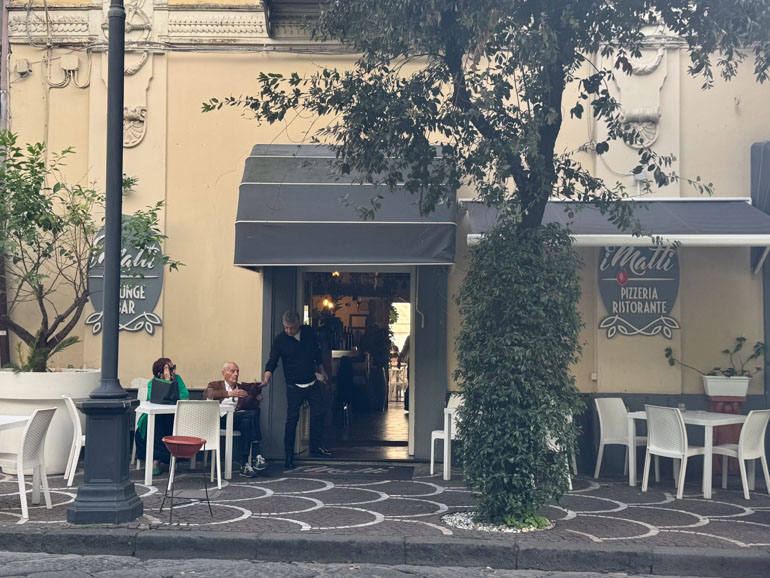
- I Matti -Pizzeria Ristorante
-
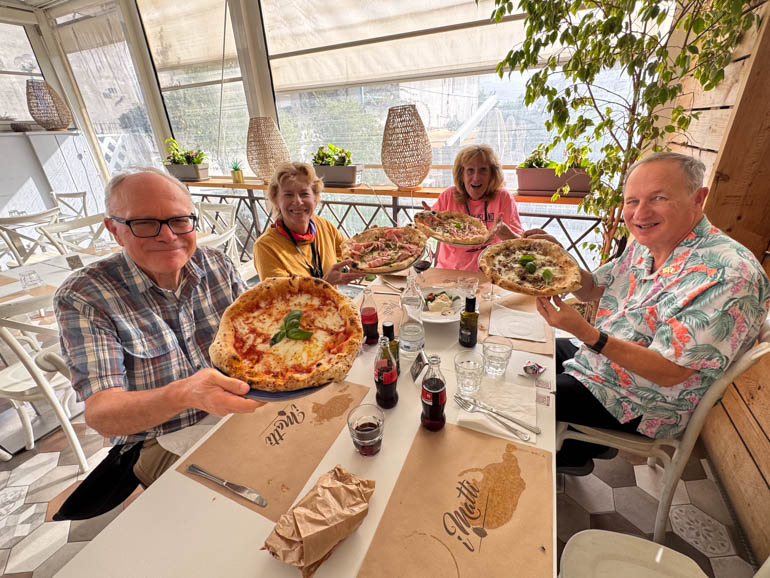
- The pizzas were hot and delicious
-
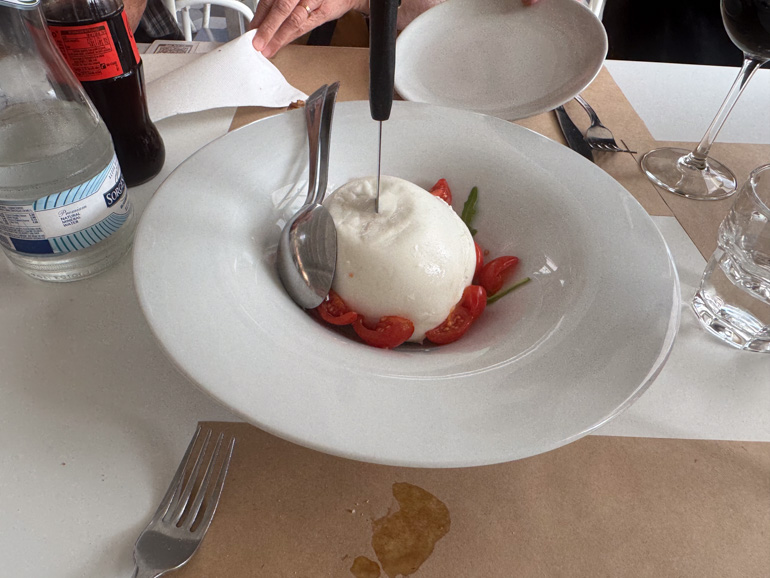
- Buffalo mozzarella is a mozzarella made from the milk of the Italian Mediterranean buffalo
-
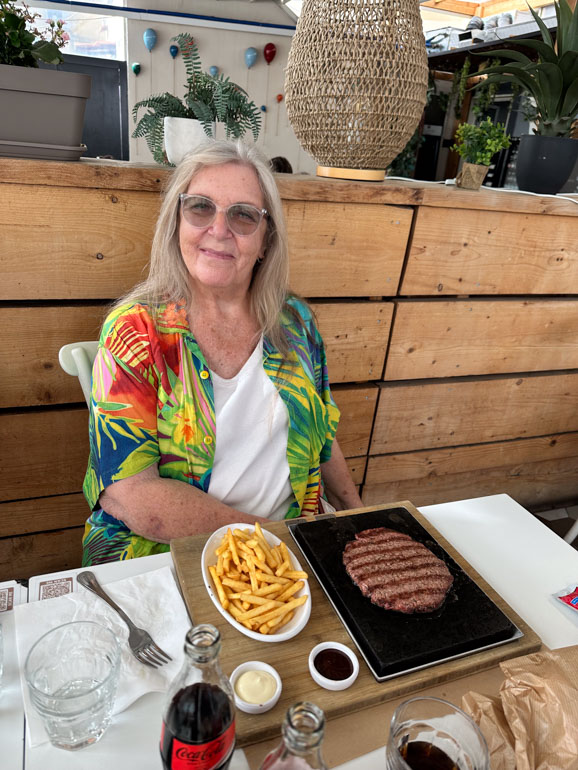
- Judy ordered a large burger
Exploring Pompeii
We met our guide, Giovanni, just before 2:00 PM. outside the main entrance and began a two-hour walking tour that took us counterclockwise through the southern and central parts of the site.
Even after two hours, we covered only a fraction of Pompeii’s 160 acres — but enough to glimpse nearly every facet of Roman life: leisure, faith, commerce, and tragedy.
-
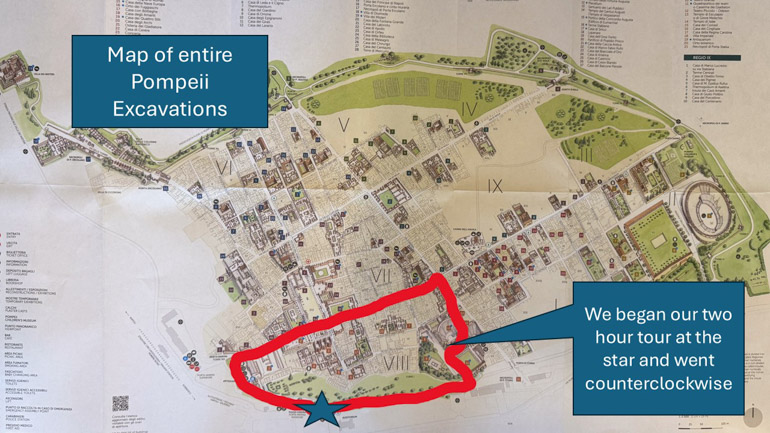
- This map shows the entire complex – we followed the red rectangular path
-
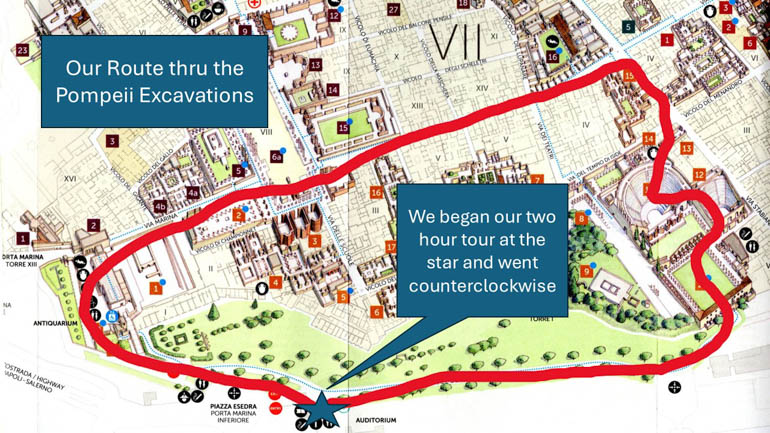
- This is a close up or our walking route – we covered only a small fraction of the entire site
Entrance & Ticket Office
We began near the Porta Marina gate and ticket office, with Mount Vesuvius visible in the distance — a constant reminder of the disaster that struck in AD 79.
Gymnasium (Palestra Grande)
Our first major stop was the Gymnasium, an open courtyard once used for youth athletics and military training. The volcano loomed beyond its walls — both beautiful and ominous.
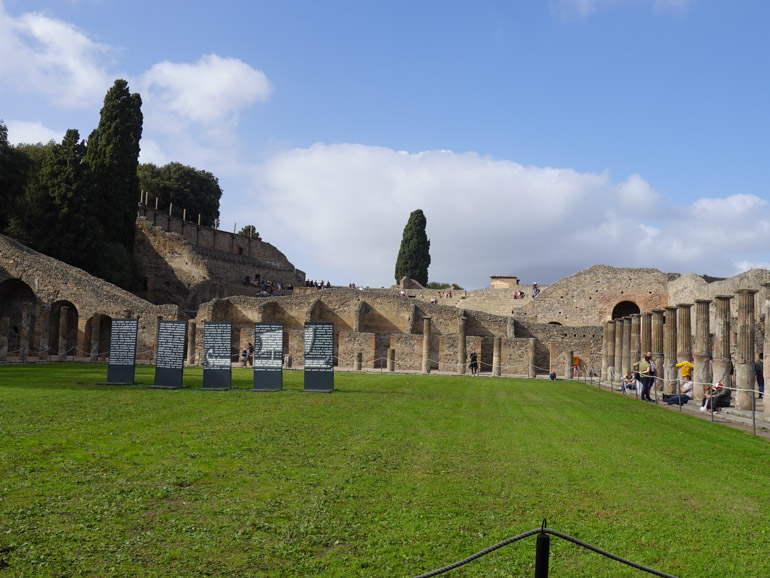
The Large Palaestra, once used for youth athletic training
Small & Large Theatres
Next, we visited the Odeon (small theatre), used for music and poetry, and the Great Theatre, which still hosts performances today. Giovanni demonstrated the superb acoustics — a sharp hand clap was easily heard everywhere.
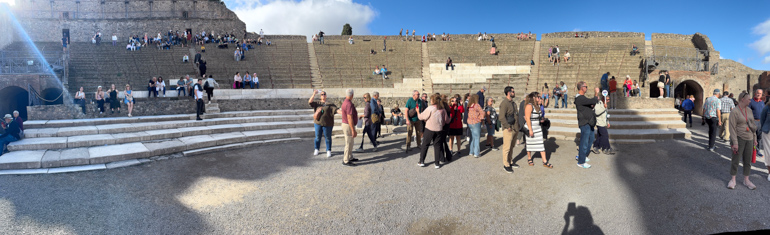
Great Theatre of Pompeii (Teatro Grande) — one of the oldest and best-preserved stone theaters in the Roman world. Built in the 2nd century BC, it could seat about 5,000 spectators and was carved directly into a natural hillside for support.
Via dell’Abbondanza – Pompeii’s Main Street
Turning onto Via dell’Abbondanza, we passed rows of thermopolia — ancient snack bars where locals once grabbed food to go. Terracotta jars built into the counters held soups and stews, making them the Roman version of take-out.
-
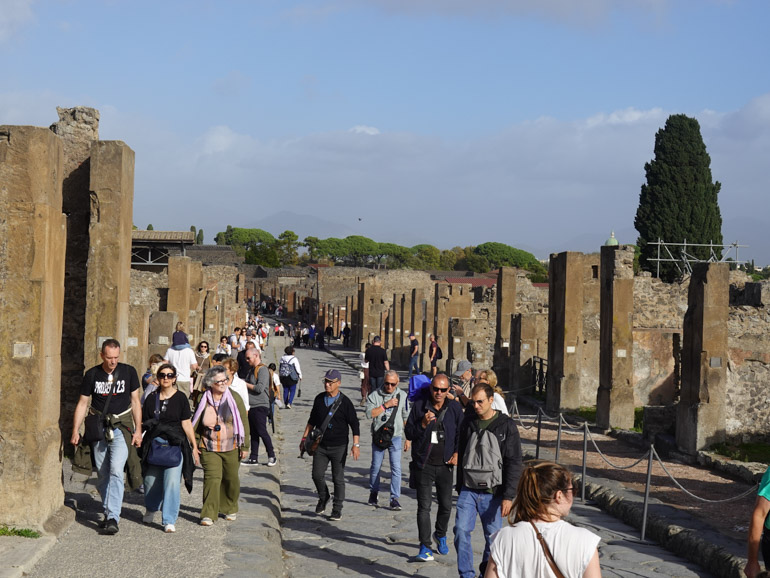
- Via dell’Abbondanza, Pompeii’s main thoroughfare
-

- This is a street intersection in Regio VII of Pompeii, near one of the city’s main crossroads along Via dell’Abbondanza. The large stepping stones allowed pedestrians to cross when the streets were filled with water or waste, while gaps between the stones let carts pass through
-
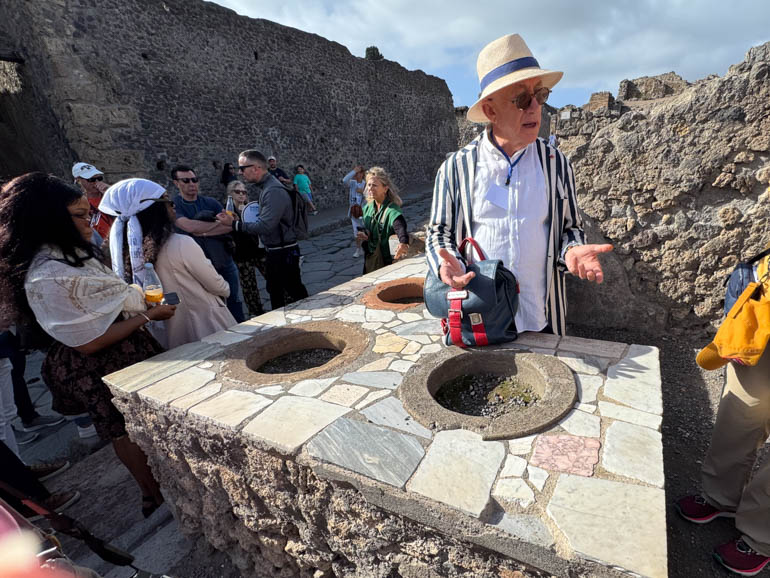
- Giovanni explains the ancient thermopolium — the Roman version of a take-out counter
Private Homes & Baths
We stepped into the footprint of a typical home, its central atrium and kitchen clearly defined. Nearby, the Stabian Baths displayed remarkable Roman engineering — complete with saunas, showers, and changing rooms.
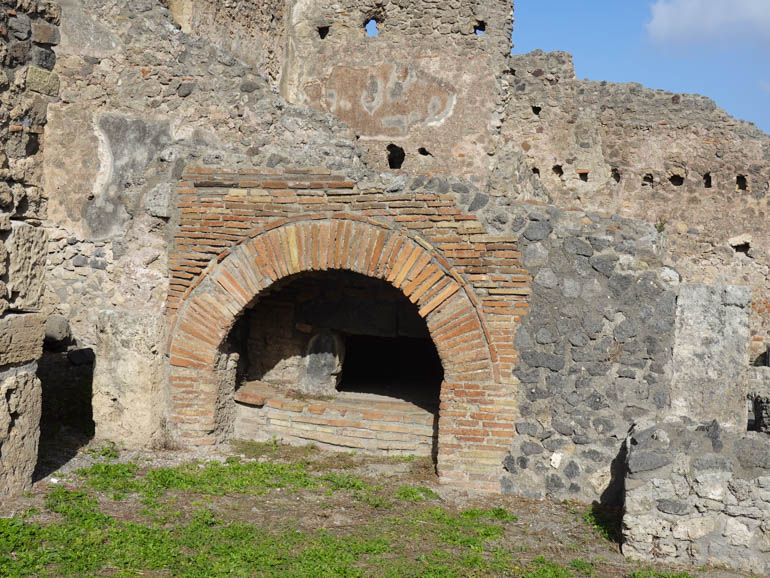
This is a Roman bakery oven (forno) in Pompeii. The arched brick structure is part of a pistrinum, or bakery, where bread was baked daily for the city’s residents
The Brothel Street (Lupanare)
We walked up the street leading to Pompeii’s famous brothel, but the line was too long to enter. Giovanni instead showed us laminated photos of the interior frescoes — surprisingly vivid scenes that once guided patrons to individual rooms.
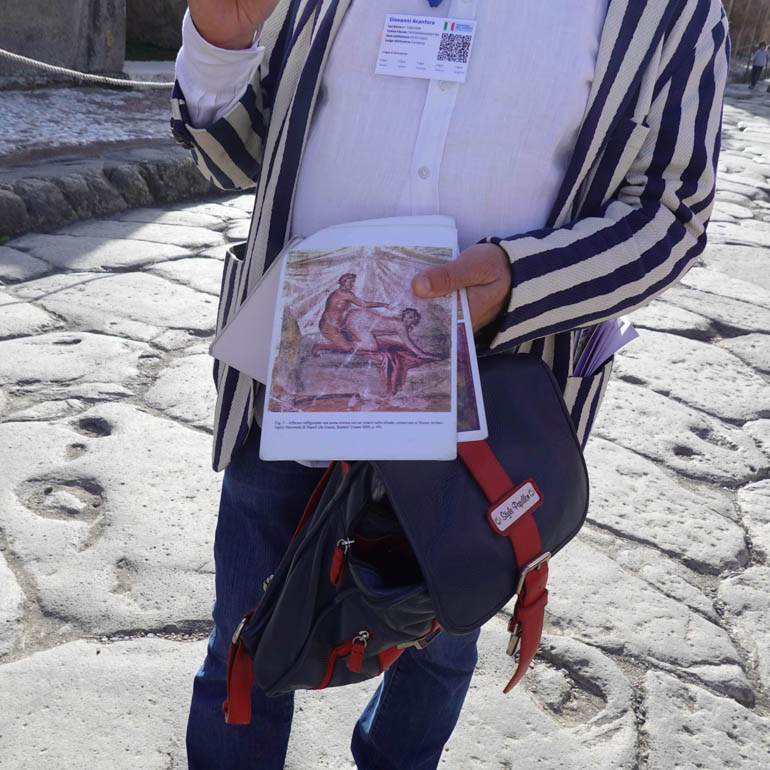
Giovanni showed us laminated photos of the interior frescoes – the lines to see them in person were long
Public Fountains & Water System
Along the route, we paused at a stone fountain, its carved face still fed by the original aqueduct. These fountains were everyday gathering spots where residents filled amphorae on their way home.
The Forum & Temples
We emerged into the Forum, the civic and religious heart of Pompeii, surrounded by temples and public buildings that once framed the city’s most important square. Dominating the northern end stood the Temple of Jupiter, dedicated to the Capitoline triad of Jupiter, Juno, and Minerva, with Mount Vesuvius rising behind it. To the west side of the Forum stood the Temple of Apollo, one of Pompeii’s oldest sanctuaries, while nearby the Temple of Vespasian honored the deified emperor and featured a small marble altar used for sacrifices, still beautifully preserved today.
-
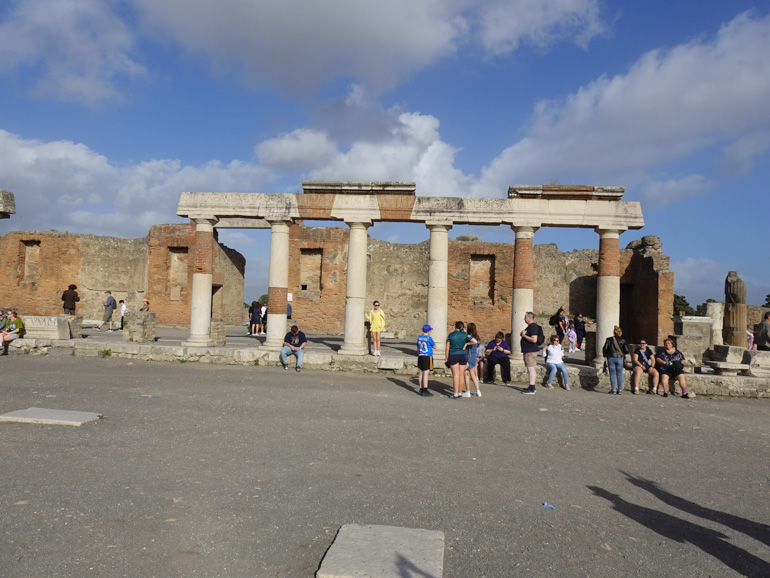
- This is the Temple of the Genius of Augustus, also known as the Temple of Vespasian, located on the western side of Pompeii’s Forum.
-
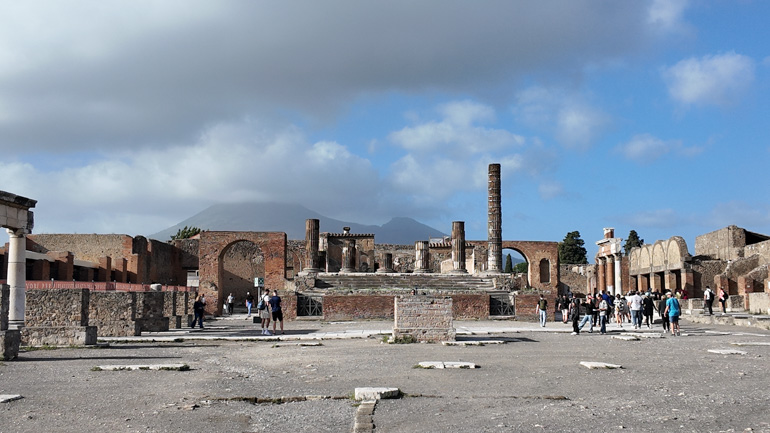
- The Temple of Jupiter stands at the northern end of the Forum, directly aligned with Mount Vesuvius in the background (you can see its peak framed behind the temple)
The Plaster Casts
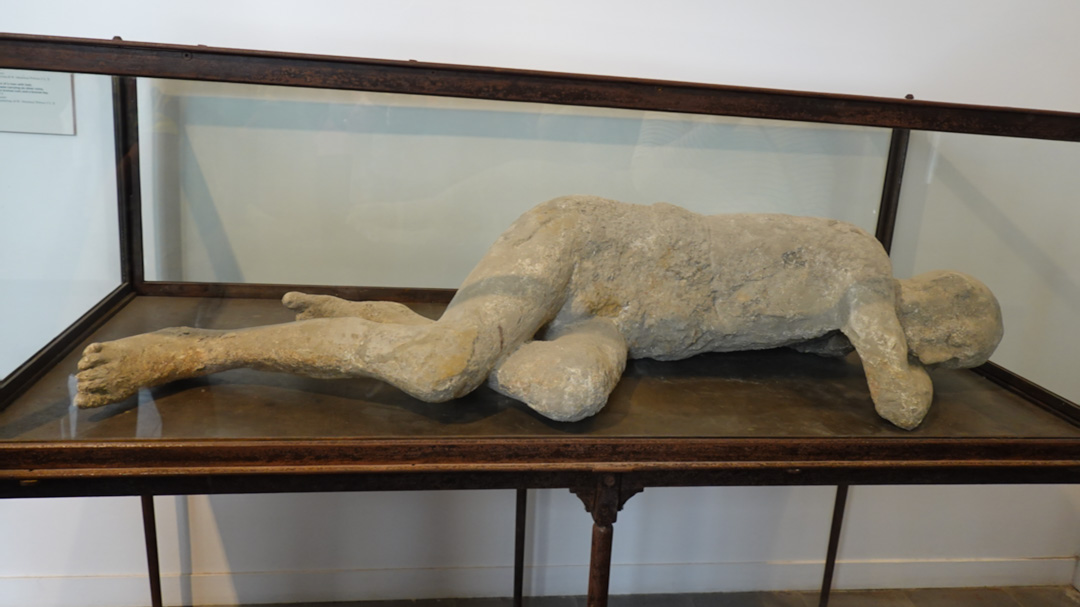
Our final stop was the exhibit hall, which contained the haunting plaster casts — detailed impressions of men, women, and children frozen in their final moments. Seeing them up close was a powerful reminder that Pompeii was not just ruins, but a city of real lives abruptly ended.
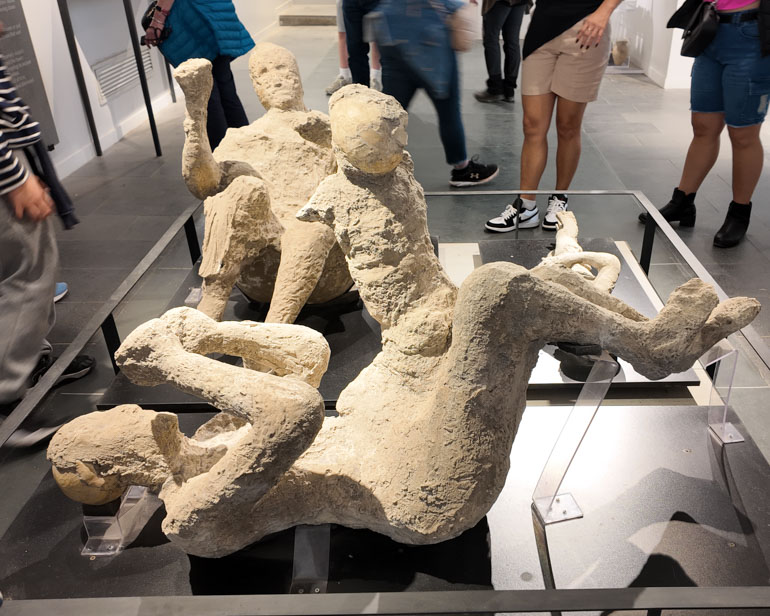
Plaster casts of Pompeii’s victims — haunting impressions of residents caught in their final moments as volcanic ash engulfed the city in AD 79
We exited the site around 4:00 p.m., met Roberto, and began the drive back to Naples. Along the way, we noted that gasoline was €1.75 per liter — roughly $7 per gallon.
We reached the terminal around 4:30 p.m., browsed a few shops, and were back in our cabin by 5:00 p.m.
Evening Onboard
Suzanne Godfrey was the featured performer this evening. Her flute performance, Flutopia, blended world and film music in a dynamic set that included Jai Ho from India, Lambada from Brazil, Michael Jackson’s I Just Can’t Stop Loving You, and Caruso by Lucio Dalla in tribute to Enrico Caruso.
The program closed with themes from Gladiator and Game of Thrones, finishing with A Sky Full of Stars by Coldplay.

Flutist Suzanne Godfrey performing “Flutopia,” blending pop and movie themes
0 Comments