
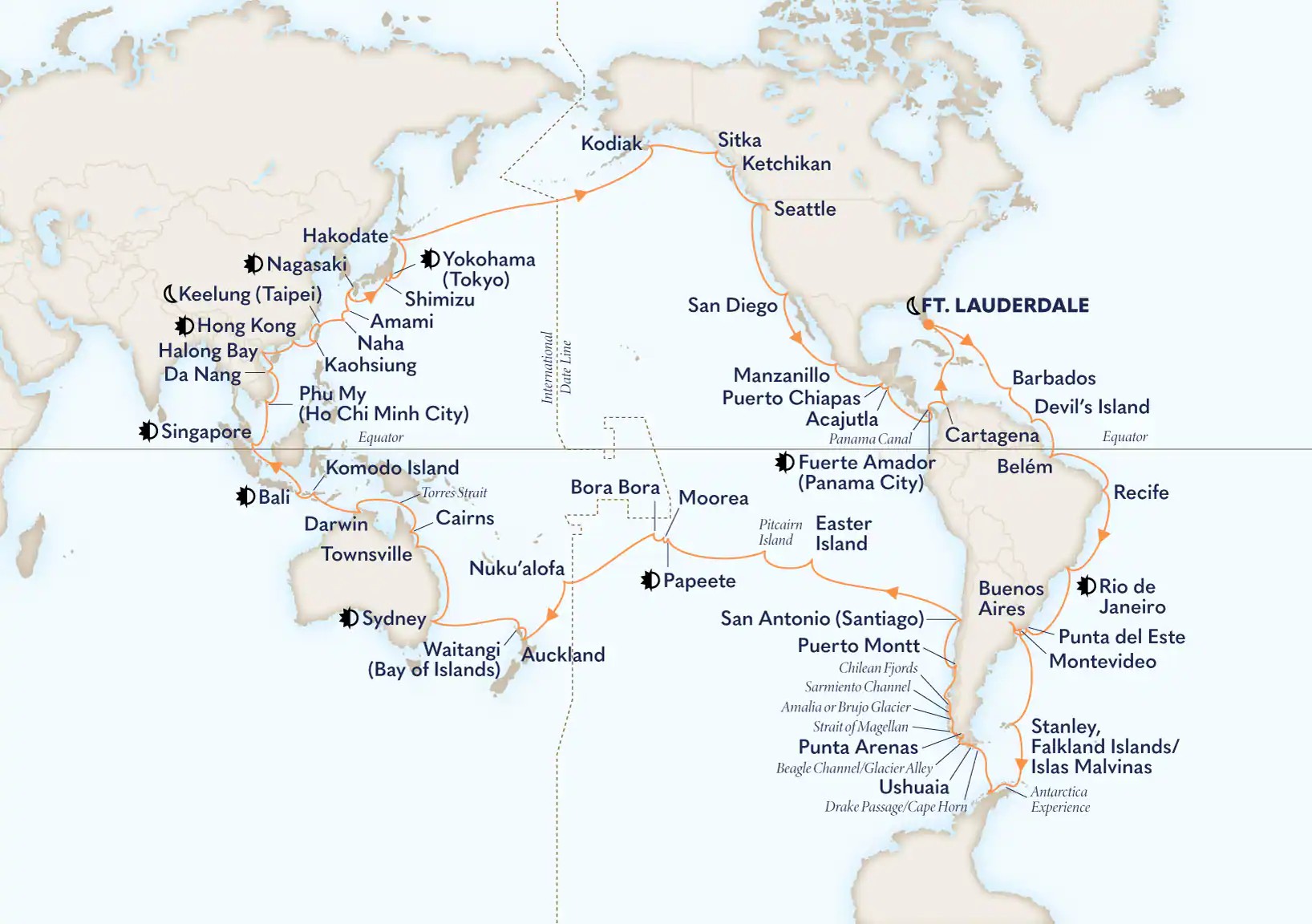
What to Eat in Buenos Aires: A Walking Food Tour of the City’s Classic Dishes

A walking food tour through Buenos Aires led us from historic pastry shops to classic neighborhood eateries, sampling empanadas, pizza, chorizo, and alfajores along the way.
Buenos Aires Food Walk with Ines
January 23, 2026 | Buenos Aires, Argentina
We spent the day in Buenos Aires on a small-group food walk with our guide Ines Ruggiero, which we booked through With Locals. It turned into a fantastic way to explore the city, moving from pastry shops to classic neighborhood eateries while learning about local food traditions.
Getting Ashore
The port for Buenos Aires is primarily a commercial container port, so cruise passengers need to take a shuttle to the cruise terminal and then another shuttle into town. The cruise terminal itself is large and designed to handle embarkation and debarkation for multiple ships. Inside are a few small shops and a couple of restaurants.

Photo from deck 7 showing commercial port and location of port shuttle
Once at the cruise terminal, you can walk into town or take a taxi or Uber. We decided to take the Holland America shuttle to the Plaza Hotel across from Plaza San Martín, then walk the 1 mile down pedestrian-only Florida Street, lined with shops and restaurants, to our tour meeting point at Plaza de Mayo by 11 AM.
-

- Shuttle bus from the cruise terminal to Plaza Martin
-
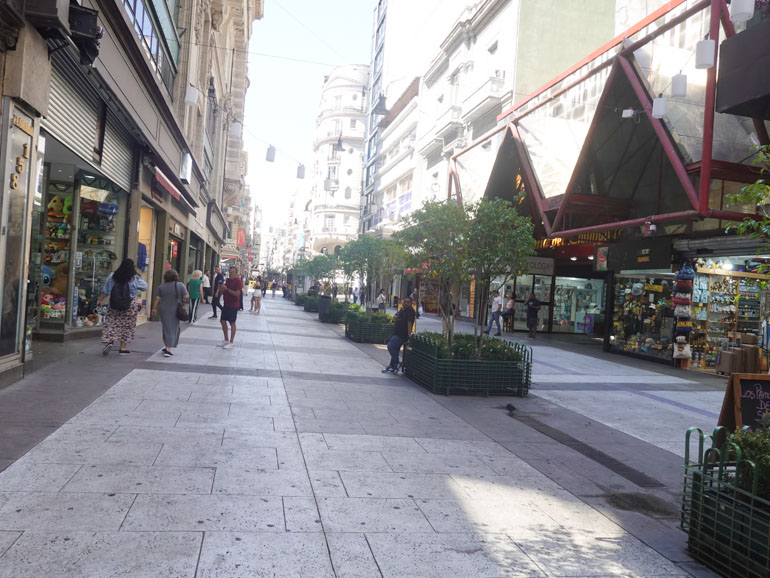
- Florida Street is a nice place to walk and people watch
Note: Taxis in Buenos Aires do not usually accept credit cards and may or may not use a meter. It is easier to use Uber with its transparent pricing and more reliable service. Sometimes it can be hard to get an Uber near a cruise terminal since access may be restricted to taxis. If we wanted to go further, we would probably take the shuttle to the Plaza Hotel and then get an Uber from there.
We met Ines in Plaza de Mayo at the top of the stairs leading to the subway station. After introductions, we were on our way.
Stop 1 | Medialunas at La Piedad
Our first stop was the historic pastry shop Confitería La Piedad.
Here we tried medialunas, one of Argentina’s favorite breakfast pastries.
Medialunas are somewhere between a brioche and a croissant. They are made from a sweet enriched dough with eggs and butter, laminated into thin layers, and lightly flavored with lemon and vanilla. They are not overly sweet and pair perfectly with coffee.
While we were there, Ines showed us her mate gourd and prepared some mate for us to sample. The traditional Argentine infusion is made from the leaves of Ilex paraguariensis. It is prepared in a small gourd and sipped through a metal straw called a bombilla. Mate contains caffeine and antioxidants and is often shared socially, with everyone in a group drinking from the same gourd.
-

- Exterior of Confitería La Piedad pastry shop
-
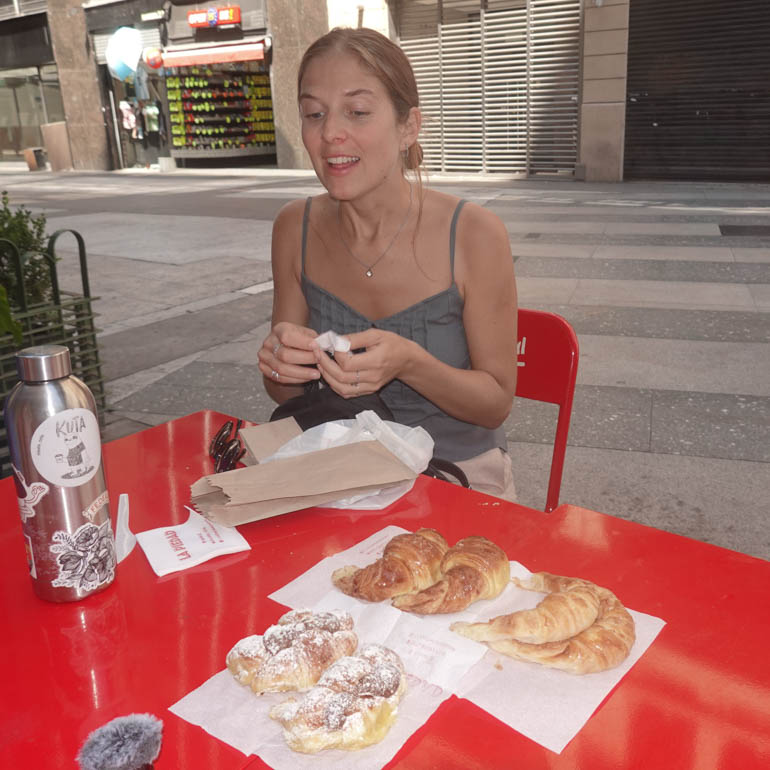
- Guide Ines Ruggiero explaining Argentine food traditions as we sampled medialunas de manteca and medialunas de grasa at Confitería La Piedad.
Stop 2 | Empanadas at La Cocina
Our second stop took us down into a small basement shopping arcade to La Cocina Empanadas, exactly the kind of place you might walk right past if you were exploring on your own. It is one of the reasons we enjoy food tours so much. Local guides know where the hidden favorites are.
At La Cocina, we sampled two freshly baked empanadas catamarqueñas, a regional style from Catamarca Province in northwest Argentina. They arrived piping hot from the oven, so we cut them open to let the steam escape before taking our first bites. The pastry was baked and sealed with a carefully braided repulgue edge.
The first was a classic beef empanada (carne) filled with chopped beef, onions, hard-boiled egg, green olives, and spices such as paprika and cumin. Beef empanadas are considered the traditional version across Argentina, and this one had a rich, savory flavor.
The second empanada was called a Pikachu, a house specialty filled with cheese, onion, and a mild spice. Despite the name, it has no connection to Pokémon. The filling was creamy and slightly savory, providing a nice contrast to the more traditional beef empanada.
Both empanadas were baked rather than fried with the neatly crimped edges typical of the Catamarca style.
-

- Sign for La Cocina Empanadas Catamarqueñas
-
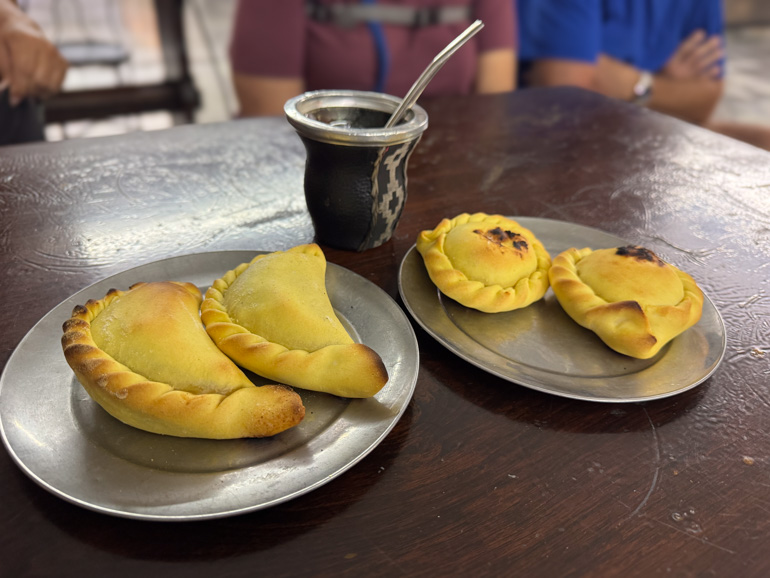
- Traditional mate gourd and bombilla with empanadas
Stop 3 | Sandwiches at Paulín
Next, we walked to the legendary sandwich counter Café Paulín.
Ines called ahead and secured five seats along the bar, which saved us from a long wait.
Paulín is famous for its theatrical service. The sandwiches are assembled in the kitchen and then slid down the counter to the servers.
Ines ordered the Académico sandwich, one of their classic creations. The sandwich is built on a crusty roll and layered with roast beef or pork, ham, cheese, lettuce, tomato, sliced egg, and mayonnaise, creating a tall and satisfying combination of flavors.
It is essentially the Buenos Aires version of a stacked deli sandwich.
-
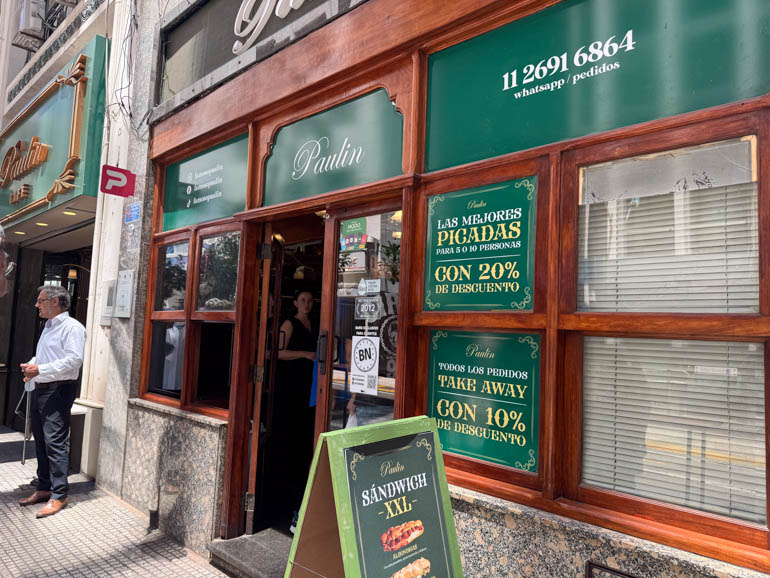
- Exterior of Café Paulín
-
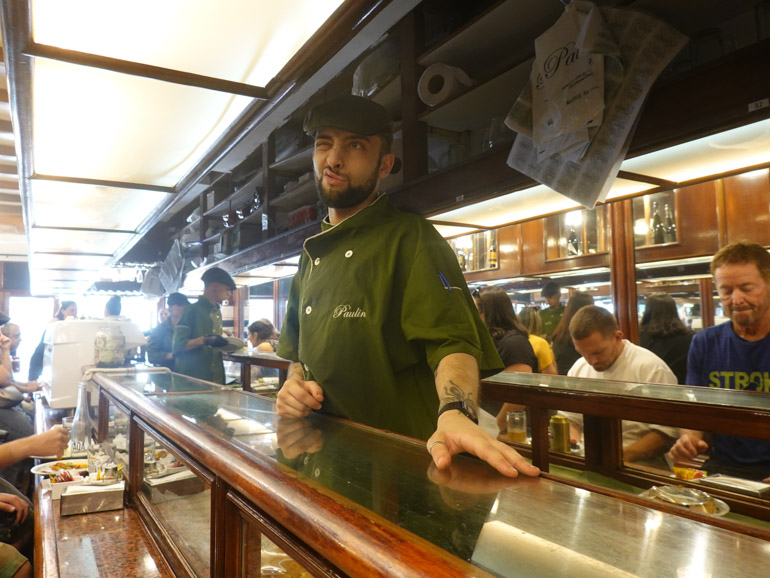
- Sandwich counter at Café Paulín where dishes slide down the bar to servers
-
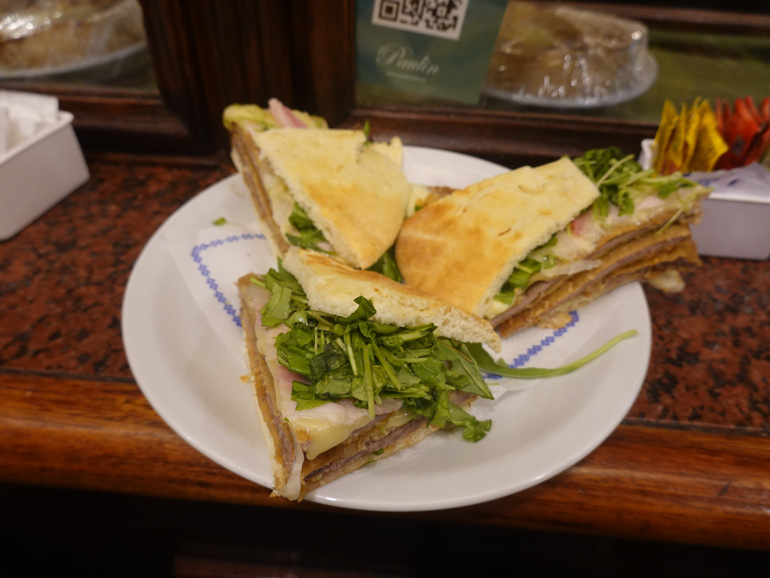
- Classic stacked “Académico” sandwich at Café Paulín
We enjoyed watching the waiters retrieve the sandwiches on dishes sliding down the bar. If you visit on your own, be prepared to wait in line. The food is great, and the spectacle is even better.
Stop 4 | Pizza at Las Cuartetas
Next we walked to one of Buenos Aires’ most famous pizzerias, Pizzería Las Cuartetas.
It sits directly across from the theater Teatro Gran Rex.
Ines explained that locals often eat pizza after seeing a show, and Las Cuartetas is a classic spot for that tradition.
Ines ordered two iconic items. The first was a fugazza, a thick Argentine-style pizza made with a soft dough brushed with olive oil and topped generously with sliced onions and oregano. When cheese is added it becomes a fugazzeta, but ours was the traditional onion-topped version.
She also ordered fainá, a thin slice made from chickpea flour, olive oil, and water that originated with Italian immigrants from Genoa. In Buenos Aires it is common to place the fainá directly on top of a slice of pizza before eating it, a tradition brought by Italian immigrants from Genoa.
We sat in the back section of the restaurant, a large room with low tables and few frills.
-
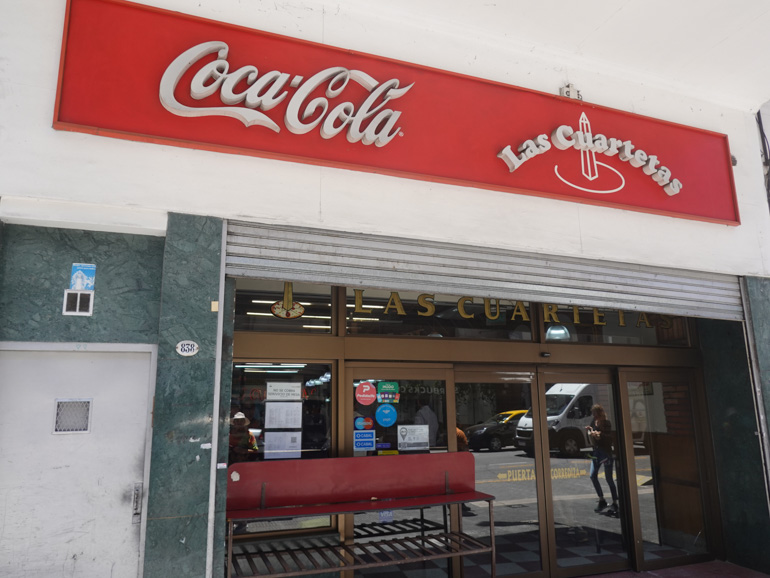
- Entrance to the famous Buenos Aires pizzeria Las Cuartetas
-

- Pizzeria Las Cuartetas interior – this is the front seating section – the back seating area is much larger
-
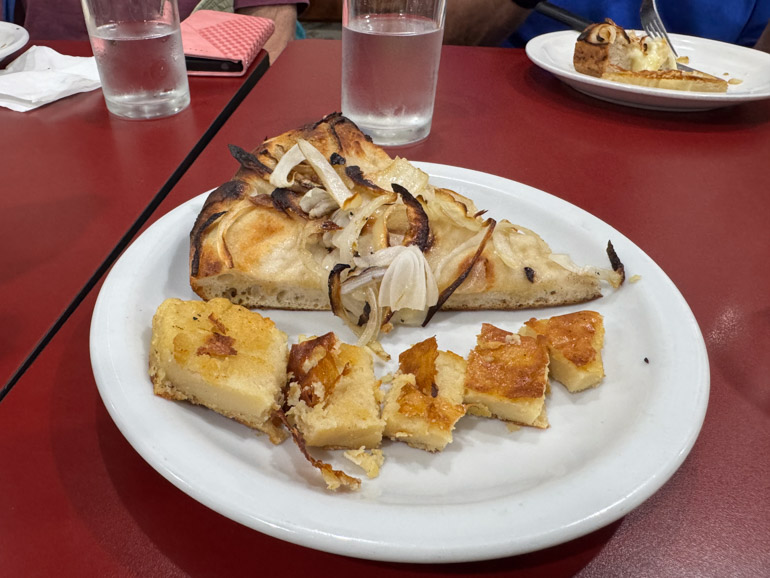
- Fugazza pizza topped with onions (top of plate) at Pizzería Las Cuartetas and Fainá (bottom)
Stop 5 | Chorizo at Almacén Suipacha
Our next stop was Almacén Suipacha, a neighborhood restaurant known for traditional Argentine cooking. Here we were served chorizo criollo with chimichurri, one of the most classic dishes you will find in Argentina.
Chorizo criollo is a fresh pork sausage seasoned with garlic, paprika, and herbs. Unlike Spanish chorizo, which is cured and dried, the Argentine version is grilled fresh over charcoal until the casing becomes slightly crisp while the inside remains juicy and flavorful.
This sausage is a staple of an asado, Argentina’s traditional barbecue, and it is often served as the first course while the larger cuts of beef finish cooking on the grill. Our plate arrived with two beautifully browned sausages, simply served over a few greens and accompanied by chimichurri, the bright herb sauce made with parsley, garlic, vinegar, olive oil, and chili flakes that appears on almost every Argentine table.
-

- Exterior of Almacén Suipacha
-
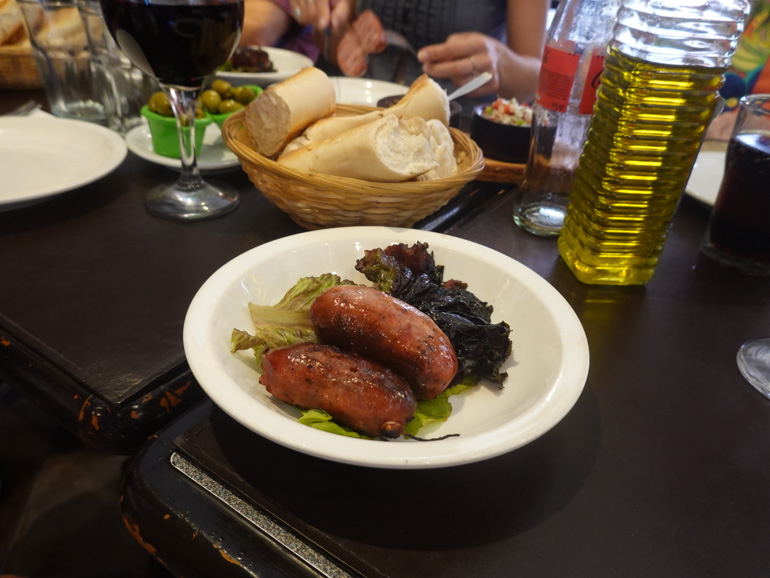
- Chorizo criollo with chimichurri at Almacén Suipacha
Stop 6 | Desserts at Confitería La Ideal
Our final stop was the beautiful historic café Confitería La Ideal, one of Buenos Aires’ most famous pastry shops.
Here we sampled a small assortment of classic sweets, including:
- alfajores
- macarons
- petits gâteaux
The star of the plate was the alfajor, Argentina’s most beloved sweet. These soft cookies sandwich a generous layer of dulce de leche and are often finished with powdered sugar, chocolate, or coconut. The version we tried had delicate cookies and a rich caramel filling.
The macarons added a lighter French-inspired touch, while the petits gâteaux showcased the elegant pastry tradition found throughout Buenos Aires.
Confitería La Ideal dates back to 1912 and is one of the city’s historic confiterías, grand cafés where locals gather for coffee, pastries, and long conversations. With its high ceilings, ornate décor, and bustling dining room, it felt like stepping back into another era of Buenos Aires café culture.
After dessert, we said our goodbyes to Ines and the rest of the group around 4:00 PM, bringing a very enjoyable afternoon of food and conversation to a close.
-

- Grand dining room inside Confitería La Ideal
-
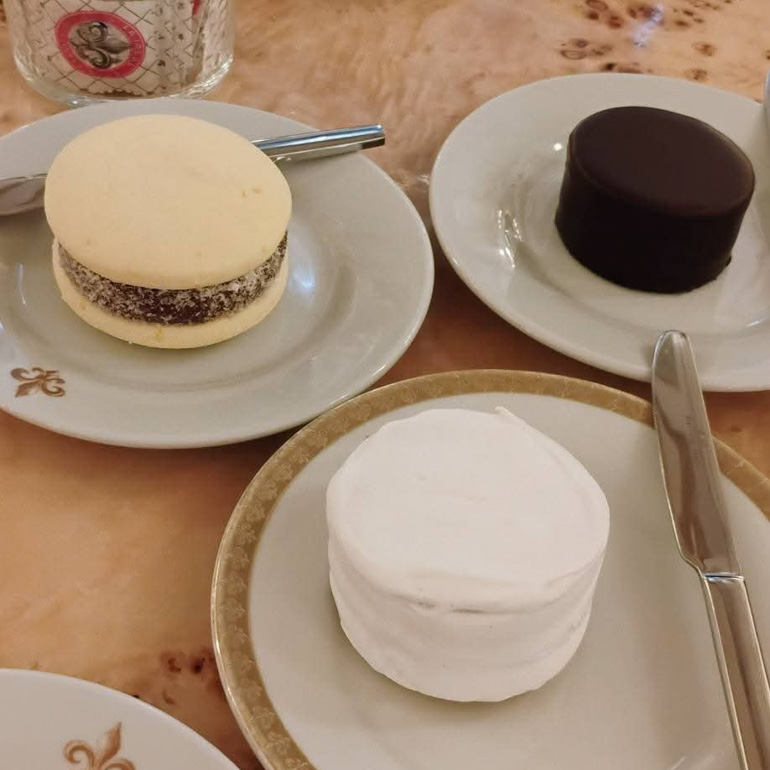
- Alfajores, macarons, and petits gâteaux desserts
-
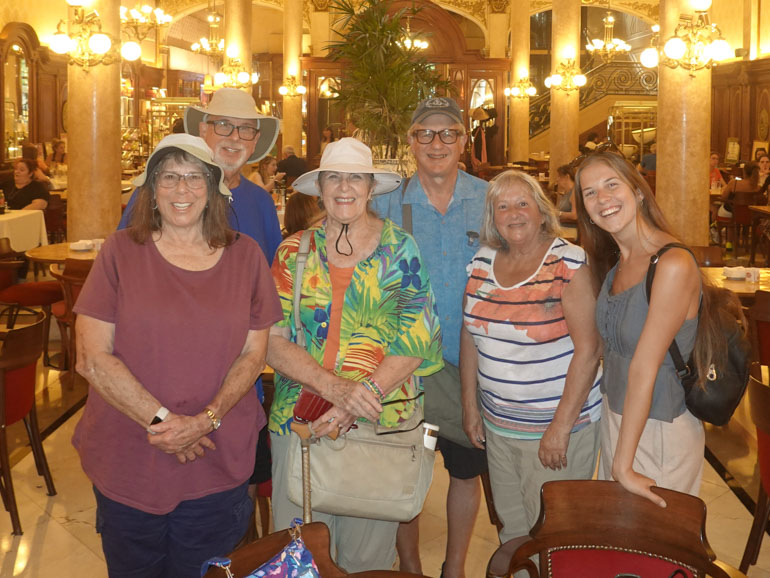
- Our food tour group at historic Confitería La Ideal
The food walk with Ines was a wonderful way to experience Buenos Aires. In just a few hours, we moved from traditional pastry shops to neighborhood restaurants and historic cafés, sampling dishes that locals eat every day. Along the way, we learned about Argentine food traditions and the city itself. Food tours like this are one of our favorite ways to explore a new place because you discover hidden spots you might never find on your own while enjoying a relaxed afternoon of great food and conversation.
Heading Back to the Ship
With an all-aboard time of 5:30 PM, we had about 90 minutes to try to visit one more yarn shop, Milana Hilados, located a few miles away. I attempted to order an Uber, but the first ride showed a 10-minute wait, and then two drivers canceled, saying they could not find us at the intersection where we were standing.
I realized afterward that requesting an Uber from a busy street corner was a mistake. Large intersections offer drivers multiple possible pickup points, which can make connecting difficult. In hindsight, it would have been better to walk about 50 yards down a nearby one-way street, where the driver would have a single clear approach and an easier pickup location.
By 4:20 PM we decided not to risk waiting any longer. Instead, we walked the mile back to the shuttle stop and headed back to the ship.
Tonight’s headliner was vocalist Tenna Torres. She brought an evening of movie music nostalgia to the World Stage with her show RePLAY. Unlike most vocalists on this cruise, she was not backed by the Grand World Voyage Orchestra and instead performed with her own recorded backing tracks.

Tenna Torres
0 Comments